

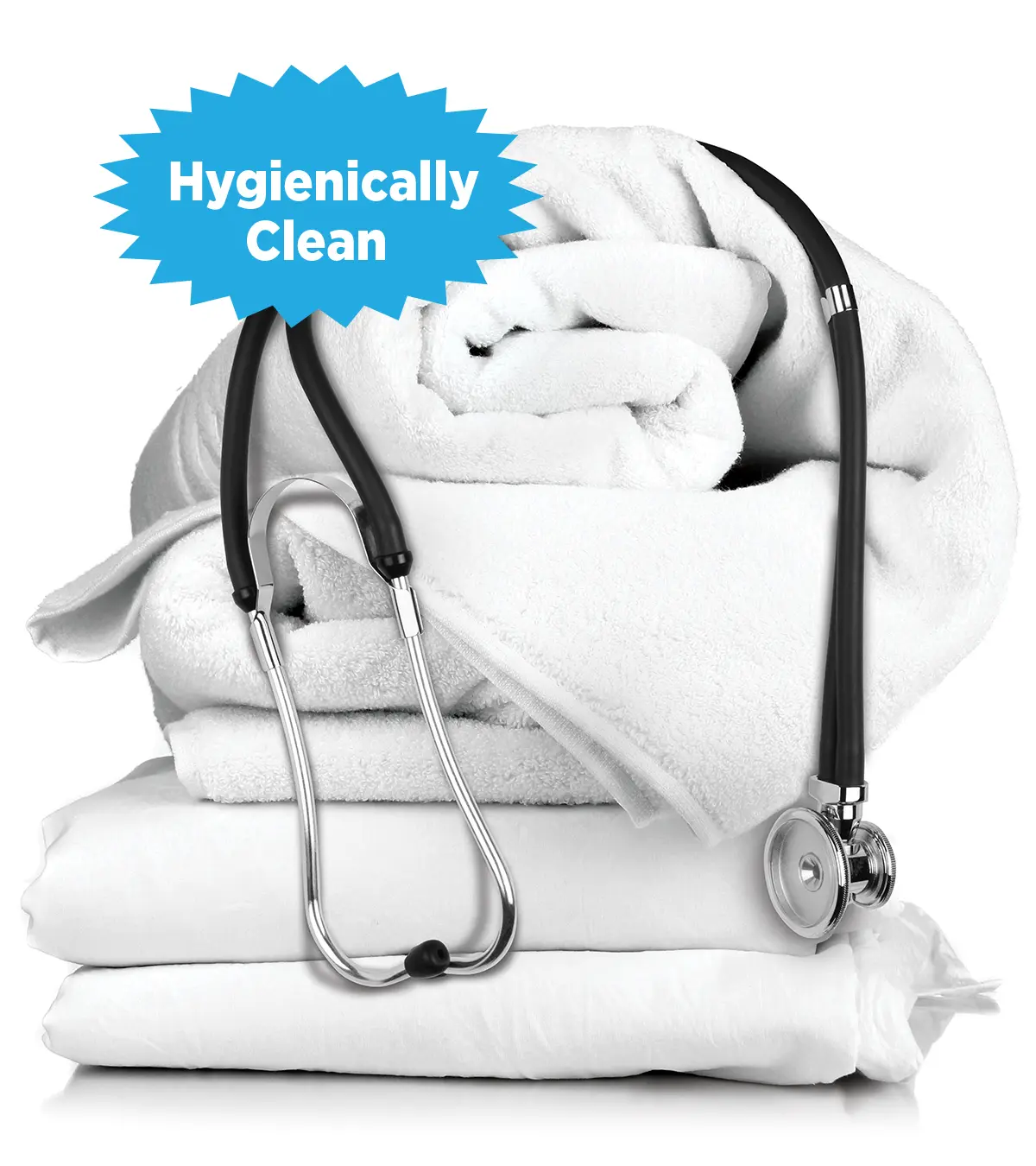
There is no broadly accepted definition within the laundry industry as to what “hygienically clean” means, however, it is generally recognized that it means that the textiles have been treated such that “bioburden” has been adequately removed so that the item can be used without fear of being a source of contamination in its intended use. AAMI (Association for the Advancement of Medical Instrumentation) defines the term “hygienically clean” as “free of pathogens in sufficient numbers to cause human illness.”
What Does “Hygienically Clean Textiles” Mean?
Recently, the Textile Rental Association of America (TRSA) has issued a standard that defines “hygienically clean” according to microbiological testing requirements. The standard to achieve their Hygienically Clean Certification requires healthcare textiles to have less than 20 cfus per 100 cm2. A cfu (colony forming unit) is a measurement that microbiologists use to enumerate bacterial contamination. Similarly, the German Certification Association for Professional Textile Services has the same limit of <20 cfus per 100 cm2 in their RAL-GZ 992/2 Standard. And the Australian Institute for Sustainability and Hygiene International, Certification Standards for Processing Reusable Linen, CSHLS 600, has a slightly different limit, <50 cfus per 100 cm2. These tests are very general and only identify the presence of microbes, not whether they are dangerous or could potentially cause disease.
Industry Standards for Hygienically Clean Textiles
There are other organizations that have taken the position that microbiological tests cannot adequately indicate the hygienically clean quality of healthcare textiles. First, the testing is extremely limited, and can only be run on a small fraction of the textiles. Second, the science has not determined what level of “incidental” microbiological contamination is safe, or more importantly at what level does general microbiological presence on textiles become a health hazard. HLAC, the Healthcare Laundry Accreditation Council indicates that controlling the process is much more critical to assure hygienically clean textiles than occasional micro testing.
Why Microbiological Testing Alone Isn’t Enough
The debate as to acceptable and unacceptable levels of microbes (whether benign or infectious) will continue. But in the meantime, laundry operations must establish process controls and monitors to make sure that they produce clean and decontaminated textiles.
How the Laundering Process Removes Bioburden
The wash process utilizes several techniques to ensure that bioburden is reduced or eliminated. These techniques include:
- a.) Dilution: Several water changes during the cleaning process physically remove and flush away bio-organisms. Mechanical action is also a factor to consider as bioburden is loosened from the fabric by proper mechanical action.
- b.) Heat: Washing at elevated temperatures (>140ºF) deactivates much of the common bio-organisms.
- c.) pH: High pH (>10.5) will “attack” or deactivate bio-organisms. In addition, large swings in pH, from neutral (7.0 – 8.0) in first flushes to alkaline (10.5 – 11.5) during the main wash cycles to acid (5.5 – 6.5) will adversely affect bio-organisms. Gurtler has a wide variety of alkaline builders that can achieve the right pH for the conditions in every laundry.
- d.) Oxidation: This is where chlorine bleach or oxygen bleach contributes to the bio-organism deactivation. Oxygen bleach is considered to be somewhat less aggressive than chlorine bleach on bacteria and viruses, however, when combined with the other cleaning factors in a laundry formula, oxygen bleach is considered effective in deactivating residual microbes. “Activated” oxygen bleaches, such as peracetic acid are also available that are recognized as more effective anti-microbials. Gurtler has a variety of bleaches that can be utilized based on the needs of each laundry
- f.) Chemical Sanitizers or Bacteriostats: Gurtler has a variety of sanitizers and bacteriostats that can be used in the final rinse to assure that all bioburden deactivated. EPA registered Validox Disinfectant or Validox Sanitizer are based on peracetic acid which can be used in one of the final rinses to assure hygienically clean textiles. Power Stat Plus is an EPA-registered sanitizer that can be used in the final step of the laundry process. Power Stat Plus has the added benefit that it remains in the fabric and can protect the textile from incidental contamination during storage and transport. Gurtler also recommends our Vis-Tex Tunnel UV System that utilizes UV light and advanced oxidation technology to ensure that the final rinse water is continuously treated to deactivate organic bioburden.
- e.) Drying: Commercial laundry textiles are dried in driers or run through ironers that achieve a linen temperature in excess of 160 ºF which effectively deactivates remaining bio-organisms.
Research Behind Hygienically Clean Textile Processing
Published reports by ALM (Association for Linen Management), TRSA, CDC (Centers for Disease Control and Prevention) and AAMI indicate that a well-designed wash formula that appropriately uses the above techniques will provide “hygienically clean” textiles.
Further, the Veteran’s Administration sponsored a research study that investigated the effect of low temperature and chemical oxidation on the “hygienically clean” aspects of the laundering process used in their laundry facilities. This study is entitled “Killing of Fabric- Associated Bacteria in Hospital Laundry by Low Temperature Washing” (Blaser, et al., Journal of Infectious Diseases, Vol. 149, No. 1, Jan. 1984, 48-57). The article concluded that there was sufficient reduction of pathogenic bacteria, even in low temperature washing (22ºC, 72ºF). It also noted that even with the elimination of chlorine bleach, adequate reduction in pathogens was observed when compared to traditional high temperature (71ºC, 160ºF) washing processes.
The Importance of Process Controls and Monitoring
To ensure proper quality Gurtler recommends comprehensive quality monitoring and control processes. These include monitoring and recording wash temperatures, making sure water levels are proper and consistent, and recording drying and steam tunnel temperatures on a regular basis. The Gurtler Vis-Tex dispensing systems all have the Vis-Tex Data Center System. The Data Center provides a comprehensive data management capability: Complete wash floor overview; real-time monitoring; customizable goal tracking dashboard; efficiency monitors and trend charts; fully customizable production reports, and more.
Plus, our Gurtler Experts on their scheduled service calls review and report all wash operations to assure proper wash formulas for each classification, and provide detailed titration data, monitoring and control pH, alkalinity and bleach levels, and more.
Ensure Consistently Hygienically Clean Textiles
Producing hygienically clean textiles depends on more than a single test or step. It requires a controlled, well-designed laundering process that integrates temperature, chemistry, mechanical action, and ongoing monitoring.
By focusing on process consistency and proper controls, laundry operations can reliably reduce bioburden and maintain textile hygiene standards that support safe use across healthcare and commercial environments.
For operations looking to improve consistency, efficiency, and overall textile hygiene, Gurtler Industries Inc. offers advanced chemical solutions, dispensing systems, and expert support tailored to your facility. Contact us to optimize your laundry process and ensure consistently hygienically clean textiles.
